

Beauty is often spoken about as if it comes with a default audience, a default body and a default set of interests. That assumption shows up everywhere, from product copy to store layouts to the way brands decide who is invited to events, who gets offered services and who is expected to care. De-gendering beauty is not about swapping labels or creating a new box. It is about removing the box entirely.
Part of the work starts with something simple but overdue: recognizing that men in beauty are not a monolith.
Some of us are cosmetic chemists. Some are makeup artists. Some are makeup content creators and those roles can overlap. Some work in beauty marketing. Some are hairstylists or hair educators. Some speak about fragrance. Some create fragrances.
When we flatten “men in beauty” into one stereotype, we erase real expertise and limit how the industry imagines participation.
Then we have to shift our mindset around how men engage with beauty in the first place. I once shared on LinkedIn that, as a male beauty writer, I am often invited to beauty events and services I cannot actually partake in. Many responses immediately pivoted to men’s grooming services and beard care. That reaction missed the point. The issue was not a lack of interest in grooming. It was that many brands still are not inclusive of my biology, even though I am a consumer.
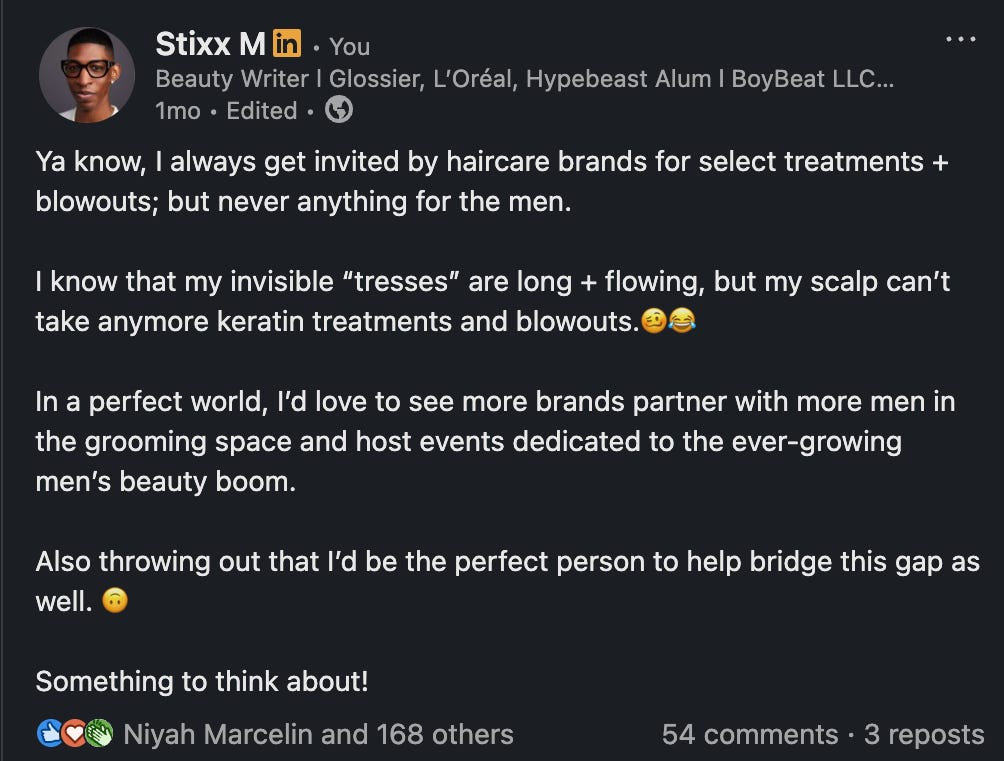
I do not grow facial hair, so while the broader conversation about men’s grooming matters, I am not the best person to lead with beard-centric framing. What I want is for commercial beauty to include men of all backgrounds in its marketing strategies and in the way brands show up in Sephora, in ads and everywhere consumers meet the category.
De-gendering Starts With Language But It Cannot End There
Brands love to say “beauty for everyone,” but their language often tells a different story.
Product benefits get coded as “women’s concerns” or “men’s concerns” when the underlying needs are human.
“For men” becomes a narrow shorthand for a specific look, lifestyle, or body.
“For women” becomes the default, and everyone else is treated like an add-on.
De-gendering beauty means describing outcomes, use cases, and sensorial experiences without assigning them to a gender. It means speaking to people as people.
Stop Redirecting The Conversation To Grooming
When someone points out exclusion, the reflex is often to redirect. For men, that redirect commonly becomes “men’s grooming.”
Grooming is a valid category. So is skincare. So is hair. So is makeup. So is fragrance. But grooming is not a substitute for inclusion.
If the only way the industry knows how to picture men in beauty is through beard care, that is not a consumer insight. That is a creative limitation.
Representation should show more than permission it should show reality
Representation is often treated like a signal, a way of saying “you can be here.” But it should do more than grant permission. It should reflect what is already true.
Men buy skincare and fragrance at scale.
Men wear makeup for artistry, confidence, performance and personal style.
Men work in every layer of the industry, not just the parts that feel “safe” to market.
De-gendered beauty is better beauty
When beauty is designed without gendered constraints, products get clearer, education gets smarter and consumers get more freedom.
We talk about skin types, not genders.
We talk about finish and payoff, not who is “allowed” to use it.
We build services around anatomy and preference, not stereotypes.
The end goal is not a world where men are simply included in a women’s space. The goal is a world where beauty is not gendered in the first place.
Beauty is for all of us.