

You know, I have those moments where things just pop up on my mind and I have something I need to say. Lately, so many people have been ringing alarms about the state of the beauty industry, amid many layoffs and brand closures — but as someone who has sat on both the brand + editorial side, I’m here to remind you to be easy. The beauty industry is NOT dead.
Headlines across beauty industry publications have painted a grim picture: mass layoffs at once-untouchable companies, beloved brands shuttering operations and investors pulling back from what was previously considered a recession-proof sector.
The conventional narrative suggests an industry in crisis, with many pointing to economic downturns, changing consumer behaviors and market saturation as culprits.
However, this perspective misses a crucial point: what we're witnessing isn't merely a crisis, but rather a fundamental and necessary reset of an industry that had lost its way amid hypergrowth and overconsumption.
For years, the beauty industry operated on a model of constant expansion, with brands churning out endless product launches, collaborations and limited editions at a dizzying pace. Social media accelerated this trend, creating an environment where consumers were constantly bombarded with the "next must-have" product before they'd even finished their last purchase. The result was predictable: beauty cabinets overflowing with half-used products, environmental concerns about packaging waste, and increasingly, consumer fatigue.
When economic pressures mounted, this unsustainable model began showing its cracks, not because beauty itself had lost value, but because the industry had strayed from delivering meaningful value to those seeking more than what was previosuly given.
What we're experiencing now should be viewed not as a collapse but as a necessary correction — a pruning of excess that will ultimately strengthen the industry's roots. The brands shutting down or scaling back aren't necessarily victims of external circumstances beyond their control, but rather casualties of an overdue reckoning with relevance and purpose.
This moment of contraction isn't the death of beauty; it's the industry's opportunity to rediscover what made it essential in the first place: genuine innovation, authentic connection through community + products that meaningfully improve the consumers' lives.
The brands that survive this shedding will be those that understand this shift isn't temporary but represents a fundamental realignment of what beauty means in our lives.
The Overconsumption Problem
The beauty industry's problem with overconsumption didn't develop overnight. It evolved gradually as social media transformed how products were marketed and consumed. Beauty influencers showcasing extensive "hauls" and "top shelfies" normalized owning dozens of similar products. Brands responded by accelerating their launch calendars, creating a constant stream of new offerings to capture attention in increasingly crowded feeds. The advent of beauty subscription boxes further normalized receiving multiple new products monthly, regardless of need or use.
This cycle created what industry insiders now recognize as "beauty fatigue"—a state where consumers feel overwhelmed rather than excited by new launches. Studies show the average beauty consumer owns more than 40 makeup products but regularly uses fewer than 10. The environmental impact has been equally concerning, with billions of plastic containers and packaging materials ending up in landfills annually. This wasteful model was supported by artificially inflated valuation metrics that prioritized rapid growth over sustainable business practices.
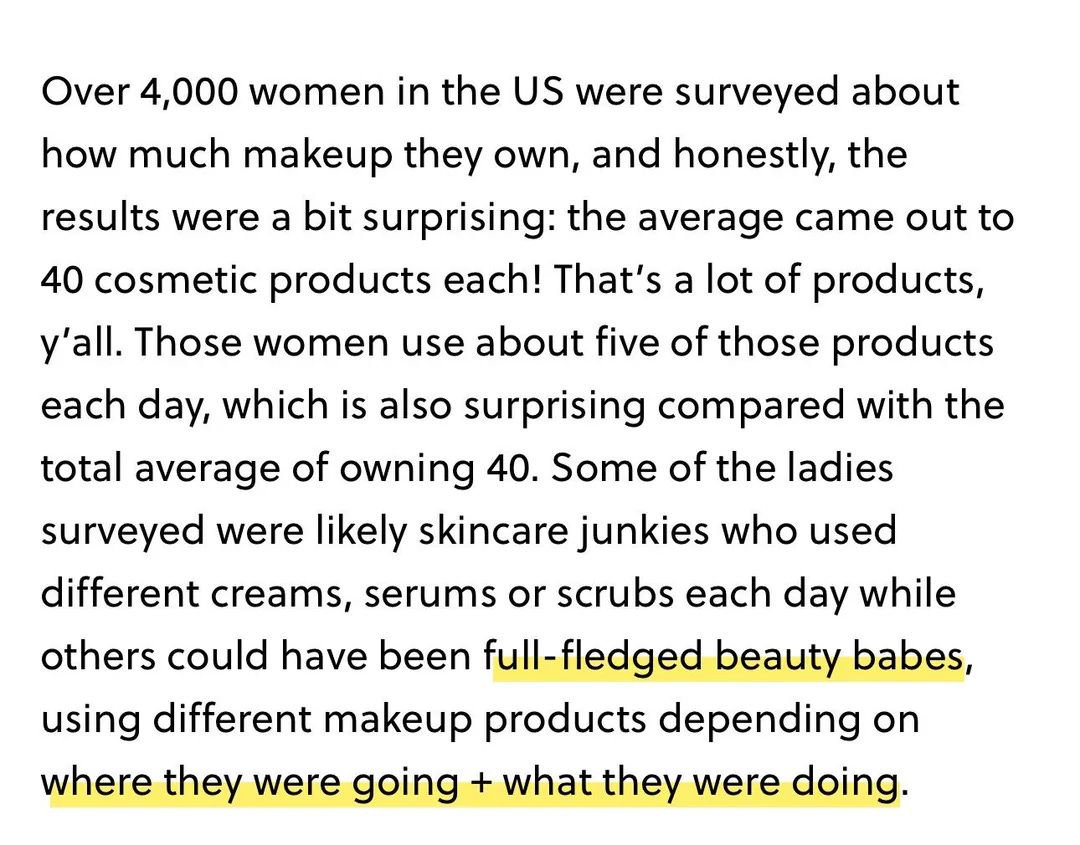
The pandemic briefly accelerated this problem through increased online shopping, but it also planted the seeds of change. As consumers spent more time at home, many began questioning their consumption habits, reassessing what products truly added value to their lives, and developing more mindful approaches to beauty. This shift in consumer consciousness collided with economic pressures to create the perfect conditions for the industry reset we're now witnessing.
Not a Crisis, But a Correction
The beauty industry's current contraction phase bears all the hallmarks not of crisis but of market correction. Consider that even in the thick of the headlines of brand closures, the global beauty market is still projected to grow — just at a more measured pace that reflects realistic demand rather than investor hype. What's changing isn't the human desire for beauty products, but rather how that desire is expressed and fulfilled in the marketplace.
This correction is targeting specific vulnerabilities in the industry. Brands built primarily on celebrity names without distinctive formulations or authentic purposes are struggling. Companies that expanded too rapidly into too many categories without establishing expertise in any are scaling back. Businesses that prioritized investor metrics over customer relationships are finding themselves without a loyal base when economic conditions tighten. These aren't signs of industry collapse but of natural selection at work in the marketplace.
Historical perspective supports this interpretation. The beauty industry has undergone similar periods of contraction and consolidation before, each time emerging stronger and more aligned with contemporary consumer values. From the simplified aesthetic that emerged after the excess of the 1980s to the clean beauty movement that followed decades of chemical-heavy formulations, beauty has consistently evolved through cycles of excess and correction. The current moment is simply the latest iteration of this pattern, albeit accelerated by social media and global economic factors.
The New Standards of Relevance
As the industry undergoes this reset, a new set of standards is emerging to determine which brands maintain relevance and which fade away.
Brands must answer increasingly hard-to-answer questions from its respective communities: Why does this product need to exist? What unique benefit does it provide that isn't already available? How does this company contribute positively to the broader world?
Efficacy has returned as a non-negotiable requirement. The era when beautiful packaging and clever marketing could sustain a mediocre product is ending. The day-to-day consumer are sharing results (or lack thereof) across platforms, creating unprecedented transparency around product performance. Brands with truly “good” formulations that deliver measurable results are weathering the storm far better than those relying primarily on marketing narratives.
Community connection has become another crucial factor. Brands that have built genuine relationships with their customers — listening to feedback, adapting to their evolving needs + creating two-way dialogue — have established resilience against market fluctuations. This represents a shift from the broadcast model of beauty marketing to a relationship-based approach that values depth over reach.
Winners in the Reset Economy
Several categories of beauty brands are not just surviving but thriving in this reset economy. The first are heritage brands that have maintained relevance through consistent quality and evolution. These companies have decades of consumer trust to draw upon and have typically been more conservative in their growth strategies, leaving them less vulnerable to market corrections.
Also succeeding are focused specialists — brands that do one thing exceptionally well rather than attempting to cover every category. These companies have developed deep expertise in their niche, whether it's a specific ingredient, skin concern, or beauty ritual. Their concentrated knowledge translates to products with genuine points of difference in increasingly commoditized categories.
Perhaps most interesting are the new minimalist brands explicitly positioning themselves against overconsumption. These companies offer edited product lines designed to replace multiple items in consumers' routines. Their emphasis on multipurpose formulations, refillable packaging and longer-lasting products directly addresses the fatigue many consumers feel toward the churn of traditional beauty marketing.
What unites these successful outliers is their understanding that beauty's value isn't in novelty or abundance but in delivering consistent quality, true innovation + meaningful brand stories.
They recognize that when consumers pare back their routines, they become more—not less—discerning about what remains.
So again, beauty ain’t dying or is dead; she is yet alive.
Beauty is 100% NOT dying 👏🏼