

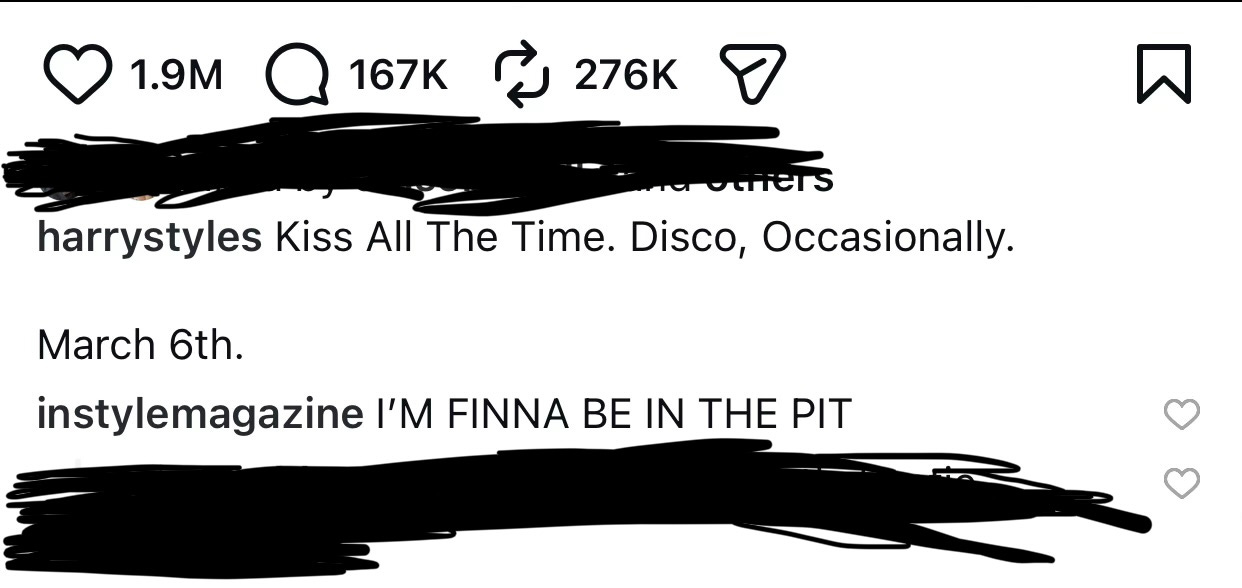
I recently came across a post from a media publication who commented on the Harry Styles news —a British man—that casually used the word “finna” in their commentary. It stopped me in my tracks. The use of that word felt jarring, out of character and deeply unsettling. It wasn’t just stylistically off-brand; it represented something far more insidious: the casual appropriation of AAVE repackaged as trendy “Gen Z slang.” As a Black person whose family history is rooted in the trauma of chattel slavery and whose parents were raised in the Jim Crow South, the feeling was more than it being just about linguistics—it was about erasure, harm and the ongoing disrespect of Black culture.
Growing up, “street slang” wasn’t celebrated in my household—it was forbidden. My parents, who survived the brutality of Jim Crow, understood that the way we spoke could determine whether we were seen as intelligent, competent or even human in the eyes of white America today. They taught us to code-switch, to speak in ways that wouldn’t be used against us, because they knew what happened when Black people didn’t conform to white linguistic standards.
To be VERY clear, this wasn’t about shame in our culture; it was about survival. And that survival instinct was born from generations of racial terror.
What many people don’t realize—or choose to ignore—is that this language developed partly as a protective mechanism. During Reconstruction and well into the mid-20th century, Black people faced violence for “speaking well” or appearing too educated around white people. Being perceived as articulate or assertive could get you killed.
Our linguistic patterns evolved not just as cultural expression, but as a necessity for safety in a country that terrorized us for existing fully. When non-Black people—especially white people and white-passing individuals—adopt AAVE without understanding this history, they’re participating in a form of cultural theft that is both tone-deaf and fundamentally racist.
Gen Z Didn’t Create This Language—They Just Stole It Better
There’s a dangerous narrative that’s taken hold online: that phrases like “finna,” “no cap,” “bussin,” “slaps,” and countless others are simply “Gen Z slang”—neutral internet language that anyone can use.
This is historical erasure at its finest. None of these terms originated with Gen Z. They are Black cultural vernacular, developed and refined within Black communities over generations. The problem is that for years, social media platforms allowed Black culture to be mined, repackaged and presented as a “free-for-all” aesthetic that anyone could adopt without credit or context.
Gen Z didn’t invent this language—they inherited a digital landscape where Black culture had already been stripped of its origins and presented as generic youth culture. TikTok, Twitter, Instagram and other platforms became spaces where Black creators would coin terms, create dances and set trends, only to watch non-Black influencers gain millions of followers by replicating that same content without acknowledgment. The algorithmic amplification of white and white-passing creators over Black ones meant that by the time these phrases went mainstream, their origins had been obscured. \
When Publications Chase Clout at the Expense of Culture
When established media publications adopt AAVE in their copy—especially when covering non-Black celebrities—they’re making a choice. HARD FAWKIN’ STOP!
They’re choosing to chase engagement and relevance by appropriating language that doesn’t belong to them, often without any Black voices in the room to flag the problem. These aren’t individual slip-ups; they’re editorial failures that reveal who is and isn’t included in the decision-making process. Publications have style guides, editorial meetings and layers of review. If AAVE is making it into published content about a British pop star, it means multiple people saw it and didn’t see an issue. (And THAT is the issue.)
This is particularly harmful because media outlets hold cultural power. When they normalize the decontextualized use of AAVE, they’re sending a message to their predominantly non-Black audiences that this language is theirs to use freely. They’re erasing the Black origins of these words and contributing to a culture where Black linguistic innovation is treated as a commodity to be exploited for clicks and relevance.
It’s a form of digital blackface—adopting the “cool” aesthetics of Blackness while remaining divorced from the lived experiences, struggles and systemic oppression that Black people face.
You Get Praised for What Gets Us Punished
It might seem harmless to some—just words, just language, just the internet being the internet. But that perspective ignores the very real harm this causes. When non-Black people use AAVE, especially in professional or public contexts, they’re often praised for being trendy, relatable or “down.” Meanwhile, Black people who speak in AAVE are routinely discriminated against in hiring processes, educational settings, and legal proceedings. Our vernacular is considered unprofessional, uneducated or improper—until someone else uses it and suddenly it’s clever and cool.
This double standard is rooted in anti-Blackness. It’s the same logic that allows white artists to profit from hip-hop while Black rappers are demonized or fashion brands to sell “urban streetwear” at luxury prices while criminalizing the Black youth who originated those styles.
The appropriation of AAVE is part of a larger pattern of extraction: taking what’s valuable from Black culture while continuing to devalue and harm Black people.
Stop Using It—We’re Not Asking Anymore
To non-Black people, especially those in media, marketing, and content creation: stop using AAVE. It’s that simple. You don’t need to say this language to connect with younger audiences. You don’t need to adopt Black linguistic patterns to seem relevant.
And if your defense is that “everyone uses it now” or “it’s just how people talk online,” then you’re admitting that you value trend participation over respecting the people whose culture you’re borrowing from.
For those who genuinely want to do better, start by educating yourself about AAVE, its origins, and its significance. Amplify Black voices and creators instead of mimicking them. Credit Black culture when you engage with it. And most importantly, understand that not everything is for you. Black people have every right to our own language, our own expressions and our own cultural spaces without them being co-opted and commodified.
Respecting that boundary isn’t censorship or gatekeeping—it’s basic human decency.
This conversation might make some people uncomfortable, and that’s okay. Discomfort is often the first step toward meaningful change. But what’s not okay is continuing to participate in the erasure and exploitation of Black culture while claiming ignorance or good intentions.
AND THAT IS ON PERIOD! (Because I can say that!)
ALL of this! I've actually made a point to stop even referring to it as AAVE and have reverted back to calling the language it's proper name, Ebonics. It's jarring and distrubing to see it used so liberally, by whoever and whenever. Not to even mention the language that are known slurs, being repackaged like P-O-N... and YN. Hard, hard, HARD stop!
This was really good. Thanks for shining light on this. What I’ve noticed is when I’m in predominantly black spaces I don’t even notice or think about this issue but when you’re in spaces with other cultures and generations, you start to notice and it’s really interesting. When I was reflecting on this I realized, and I was like this is kind of weird because I would never knowingly use vernacular from like a Hispanic culture or like European or even the African culture without permission or just to say it so when I think about it that way, it really puts things in perspective.